No products in the cart.
Blogs
How to Spot a Genuinely Vegan Pie Behind the Label

18
Oct
Oct
When you type vegan pies near me, the results can look reassuring. A bakery says vegan, a label says plant-based, and a photo shows a golden crust. But a sticker is not proof. Vegan and plant-based claims are easy to print and much harder to verify, especially when milk, butter, eggs, or shared equipment may be involved.
This guide is a buyer’s checklist for beginners who want clear answers before ordering. You will learn why a vegan pie claim is easy to print and hard to verify, what you need before you order locally, and how to evaluate four essentials: whether the ingredient list is readable, whether the crust uses shortening or butter, whether the kitchen handles dairy or eggs at all, and how shared equipment and cross-contact affect risk. You will also see red flags, green flags, a short phone script for asking a local bakery, where Bean Pie America fits, and a two-minute verification checklist. The goal is simple: help you separate a genuinely plant-based pie from smart marketing.
Why a Vegan Pie Claim Is Easy to Print and Hard to Verify
A “vegan pie near me” search returns a mixed bag: plant-based bakeries, conventional bakeries with one vegan pie, home bakers, and delivery services reselling from shared kitchens.
The plant-based market grew 54% from 2018 to 2021, and retail sales climbed from $6.9 billion in 2020 to $7.4 billion in 2021. The word “vegan” now sits on products from kitchens never built around it.
In FY 2022-23, the FDA found 13 of 210 dark chocolate products labeled “dairy-free” contained milk allergens (report). That is a chocolate finding, not a pie one. Treat it as a reason to ask questions, not proof that pie makers mislabel.
Wording matters. “Dairy free” presumes a food is totally free of milk allergens; “vegan” and “plant-based” are looser marketing terms, so why choose vegan pies is worth reading. Local claims are cheap to make and expensive to check; only a seller can say how their kitchen handles butter, cream, and eggs. Ahead: four checks, a short script, and red and green flags to sort a local option in two minutes.
What You Need Before You Order Locally
Get three things in hand: why you avoid dairy or eggs (allergy, intolerance, or preference), the ingredients that matter (milk, cream, butter, eggs, egg wash), and two minutes to question a seller before paying.
Federal law designates nine major allergens: milk, eggs, fish, crustacean shellfish, tree nuts, peanuts, wheat, soybeans, and sesame. Milk and eggs are the most common vegan-baking swaps, so ask about both every time.
As noted above, “vegan” and “plant-based” are marketing terms, not regulatory guarantees. A 2023 study in Allergy, Asthma & Clinical Immunology examined the risks these claims pose to milk- and egg-allergic consumers. A claim is not a guarantee.
About 6.2% of U.S. adults and 5.8% of U.S. children have a food allergy (CDC NCHS). A kitchen worth your order answers basic ingredient and equipment questions without deflecting.
Packaged food carries FDA-regulated allergen labeling. A pie sold at a counter or delivered by a small service often does not. So you question a person, not a panel. See our guide to tips for finding fresh pies that meet dietary requirements.
These prerequisites take minutes. You need clarity, not food-safety expertise, before searching “vegan bakery near me” again.
Check 1: An Ingredient List You Can Actually Read
Ask for the full ingredient list, not a description. “Made with plant-based ingredients” is a mood, not information. You want the fat, binder, sweetener, and thickener named, in order, as FDA labeling rules require. In a vegan pie, whatever replaced the dairy should be specific: coconut oil, vegetable shortening, oat milk, flax, aquafaba, cornstarch, or tapioca. If a list stops at “cream substitute” or “non-dairy blend,” ask what the blend is.
This matters most in heritage desserts. Traditional versions of both bean pie and sweet potato pie rely heavily on dairy, so a vegan version must replace that fat and liquid on purpose. A seller who did the work can name what they used. Bean Pie America, rooted in the African American Muslim community, describes pies made primarily from navy beans, sugar, and spices, with plant-based versions swapping cream for plant-based ingredients to reduce cholesterol and saturated fats. Ask whether the list covers the vegan or standard version; many kitchens run both. If the seller cannot or will not list the ingredients in the pie you are about to buy, treat that as an answer and keep looking.
Check 2: The Crust Is Where Dairy Hides
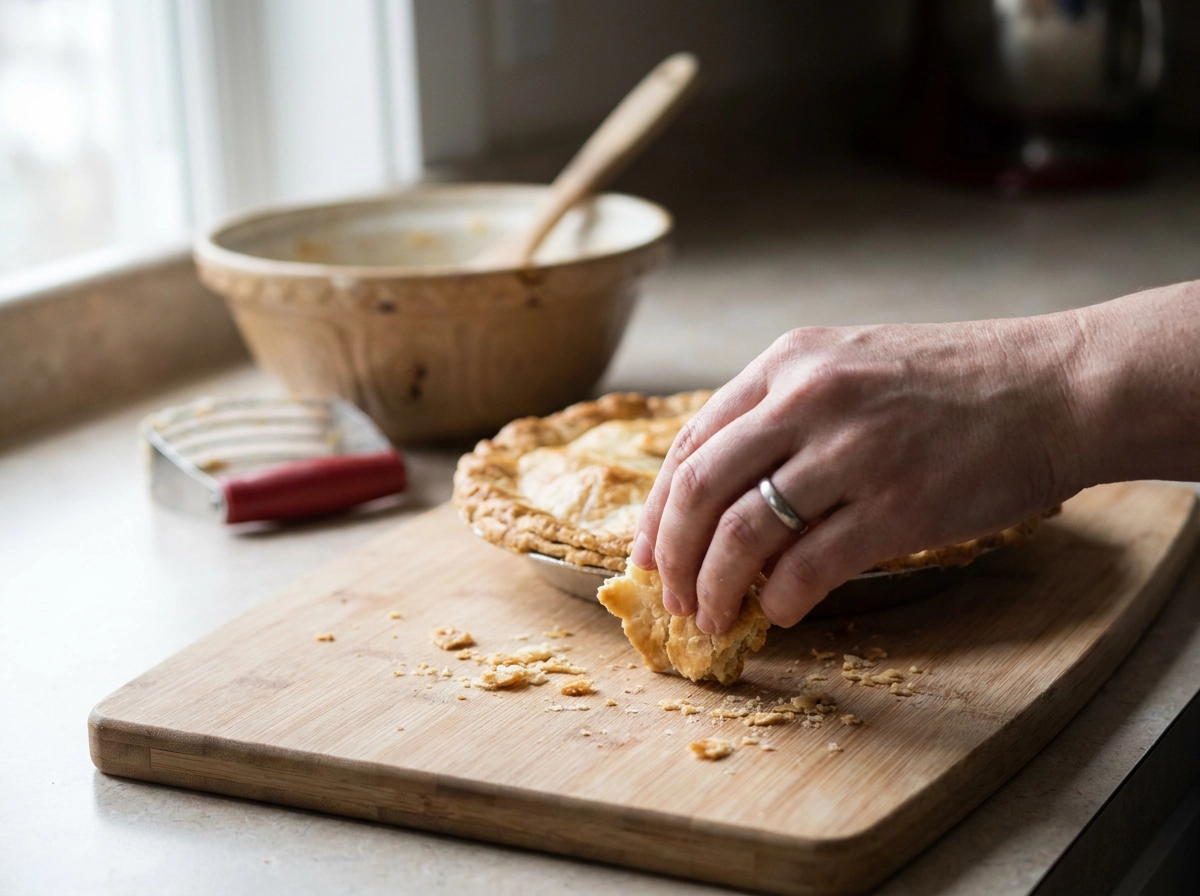
A fully plant-based filling can still sit in a crust built on butter. Traditional pie dough is made with it, and many sellers treat “vegan” as a statement about the filling alone. The single most useful question is: “Does the crust use butter, or a plant shortening or oil?” It takes seconds, earns a yes or no, and clears more ambiguity than anything else here. See Bean Pie Crust: What Makes It Unique? for how crust choices matter.
Then ask what finishes the top: an egg wash for shine, melted butter on a lattice, or an egg-based glaze can undo a vegan filling.
Crumb crusts need the same scrutiny. Graham cracker and cookie crusts can contain butter or milk powder, and they appear on bean pie, sweet potato pie, and apple crumb alike.
Watch for partial answers. “The filling is vegan” does not address the whole pie. Ask about the crust separately and note whether the seller answers directly or redirects.
A “vegan friendly” listing or a “vegan pies near me” result says nothing about the crust. No menu can run this check for you.
Check 3: Does the Kitchen Handle Dairy or Eggs at All?
With the crust settled, turn to a higher-value signal: does the kitchen handle dairy or eggs at all? A dedicated plant-based kitchen removes a category of risk a shared kitchen cannot. A bakery selling butter croissants and cream pies has different facts.
Vegan is not allergen-safe. A pie can be genuinely vegan and still made where milk is on every surface. If your concern is an allergy, ask both questions.
For a mixed kitchen, ask how the vegan line is kept separate: separate bowls, utensils, and prep times. A seller with a real process can describe it in a sentence.
Ask about eggs directly. They hide in custard, meringue, and glazes, and milk and eggs are both major allergens. “Do you use eggs anywhere in the kitchen?” beats “Is this pie vegan?”
If a seller cannot say whether dairy or eggs are present, that silence is information. It does not prove dishonesty; it means you cannot verify from outside. Delivery services are not exempt. A delivered pie was still made somewhere, and quality control issues start with asking by phone or chat before ordering.
Check 4: Shared Equipment and Cross-Contact
Even a kitchen that handles dairy and eggs can protect your pie, and the question that decides it is cross-contact. That is what happens when a vegan pie is mixed, rolled, or baked on equipment that also touched butter, cream, or eggs. It never appears in a recipe, so no ingredient list will reveal it.
Ask about specific surfaces: stand mixers, dough sheeters, rolling pins, work surfaces, baking sheets, and cutting tools. Trace dairy travels batch to batch on exactly these. Then ask about cleaning between batches and whether any tools are dedicated to the vegan line. Dedicated tools beat a cleaning schedule. Ask about timing too, since many small kitchens run plant-based items first thing in the morning on freshly cleaned equipment, before any dairy pie starts.
No public source documents bakery shared-equipment practices, so this is a question, not a lookup. Keep it proportionate: unless you need a certified allergen-free facility, you are not demanding one. You are checking whether the seller knows their own kitchen and will tell you the truth. Next, know the red flags.
Red Flags in a Local Vegan Pie Listing
Once you know what to ask about shared equipment, watch how a seller answers. The clearest red flags are quiet, not dramatic.
No ingredient list anywhere, online or on request, with the description stopping at “plant-based,” leaves you nothing to verify. A kitchen that openly sells dairy pies but calls its vegan option “totally dairy free” must describe how that separation is maintained; if it cannot, the phrase is decoration.
Vague or deflecting answers about the crust count too. “The filling is vegan” is not an answer when you asked about the whole pie.
The same goes for a recipe with no named fat or binder. If you cannot tell what replaced the cream or butter, you cannot judge the swap.
Delivery listings with no traceable brand, or a rotating “vegan” item with no notes, make your last good order impossible to repeat. As you compare online options, How to Choose the Best Online Pumpkin Pie Vendor walks through similar signals.
Treat these as reasons to keep asking, not to accuse. Many good small kitchens have simply never been asked.
Green Flags Worth Trusting
Red flags tell you to keep asking. Green flags tell you the seller has done the work.
- A named fat and binder in the ingredient list. You should see what replaced cream and eggs, such as coconut oil, flax, aquafaba, or tapioca.
- A crust answer that comes without hesitation, including the finish on top. They can name the shortening, oil, or butter substitute and say whether an egg wash or butter glaze touches the surface.
- A clear statement about the kitchen, offered before you ask. They tell you what they use, what they do not, and how shared equipment is handled. The benefits of ordering from a trusted source show up in this kind of unsolicited detail.
- Willingness to say, “I do not know, let me check,” then actually check. That beats a fast, confident answer that collapses on a follow-up.
- A consistent menu where plant-based pies are the point. Kitchens that make them often know them well.
- Room for both honest setups: a dedicated plant-based kitchen and a mixed kitchen with a real separation process.
How to Ask: A Short Script for Calling a Local Bakery

Good answers start with good questions. Copy this four-line script:
- “Is the crust vegan as well as the filling?”
- “Does your kitchen use butter, milk, or eggs anywhere?”
- “Do vegan pies share equipment with dairy pies?”
- “Can you send me the full ingredient list for the vegan version?”
Closed questions beat open ones. “Tell me about your vegan options” invites marketing language. A question answerable in one sentence is harder to deflect.
Ask by phone or chat, not by reading reviews or captions. A review describes a pie someone else ate, in a kitchen you cannot see.
Save the answer. Screenshot it or write it down. Sellers are more careful when a customer is paying attention.
Ask before you order and before you pay, while the answer can still change your decision. After the box is closed, it is too late.
These questions vet a delivered pie as well as a storefront, so a “vegan pies near me” search need not mean a drive. The same check applies when you order gluten-free desserts online.
Where Bean Pie America Fits in This Checklist
That script works on a delivery service too, and Bean Pie America is one place to run it. Bean Pie America names its ingredients specifically, the detail this checklist looks for.
Bean pie is a heritage dessert in the African American Muslim community, and the plant-based version is a deliberate reformulation. Delivery also answers local intent for some buyers. If your search for a vegan bakery near me returns a dedicated shop forty minutes away, a delivered pie meets the same need with less driving.
The menu includes bean pie, sweet potato pie, apple crumb pie, and other classics. Run all four checks on each one. Ask directly about ingredients, crust, and kitchen handling rather than assuming any pie is automatically dairy free.
Use the checklist above on any seller, including this one. The questions are the value; Bean Pie America is simply one place those answers are available.
Your Two-Minute Verification Checklist
Run four questions before you order: full ingredient list, crust fat, whether the kitchen uses dairy or eggs at all, and whether vegan pies share equipment.
Treat “vegan” and “plant-based” as claims to check, not guarantees. The dairy-free labeling problem documented in FDA testing is reason enough to ask rather than assume.
Expect rules to move. The FDA’s allergen FAQ Final Guidance, Edition 5 was announced January 6, 2025, its plant-based labeling guidance is draft, and allergen thresholds drew a public meeting in February 2026.
Pick the seller with specific answers: named fats and binders, a crust described without hedging, a kitchen discussed honestly. Searching “vegan pie near me”? Bean Pie America is one place to run this checklist.
Conclusion
A vegan label is a starting point, not proof. The four checks above, ingredient list, crust fat, kitchen dairy/egg use, shared equipment, are your strongest verification tools. When a seller gives specific answers, trust grows; when they hedge, keep asking.
Use the phone script and treat every claim as a starting point, not a guarantee. Searching for a vegan pie near me? Use this checklist on every seller, including Bean Pie America. The questions are the value, and two minutes of asking can protect your values, your health, and your peace of mind.
